
Suppose a U.S. swim brand orders private-label swim goggles from an overseas supplier for a January shipment. The product and price are agreed. One decision still affects how the order enters the United States. Will the brand act as importer of record (IOR), or will an overseas entity take that role?
U.S. Customs and Border Protection (CBP) published an interim final rule on November 6, 2026, with an effective date of January 5, 2027. The foreign-IOR entry requirements cover formal entries for consumption and informal entries for consumption that require CBP Form 3461 or 7501, including their electronic equivalents. Federal Register rule, DATES and § 141.21
Path 1 — The qualifying U.S. buyer is the IOR
- Before January 5. A buyer with the right to make entry can file under the existing procedures or authorize a licensed customs broker to file on its behalf. Federal Register rule, §§ 141.21–141.22 and statutory background
- From January 5. A buyer that qualifies as a U.S. IOR can still file if it has the right to make entry, or use a licensed broker, including one without CTPAT validation. The filer must declare U.S. IOR qualification at entry and entry summary as applicable. For a company, § 110.2 requires both U.S. location and organization under U.S. law, plus either the specified beneficial ownership and control conditions or the specified U.S. real-property condition. Have your broker confirm the qualification before the filing. Federal Register rule, §§ 110.2 and 141.22 · CBP filing bulletin
Path 2 — An overseas entity is the IOR
- Before January 5. If the overseas entity is a nonresident corporation entering goods for consumption, existing § 141.18 requires a resident agent authorized to accept service of process in the applicable state and a CBP Form 301 bond backed by a resident corporate surety. An overseas entity with the right to make entry could use a licensed U.S. customs broker without the CTPAT validation requirement introduced by the new rule. 19 CFR § 141.18 · Federal Register explanation, 91 FR 69983–84
- From January 5. For covered entries, a foreign IOR that has been validated under CBP’s Customs Trade Partnership Against Terrorism (CTPAT) program and has the right to make entry can file directly or hire a licensed broker. A foreign IOR without CTPAT validation must designate a licensed, CTPAT-validated broker to file or act as IOR. When the foreign principal has neither owner nor purchaser status, the designated validated broker must act as IOR. Federal Register rule, §§ 110.3 and 141.21
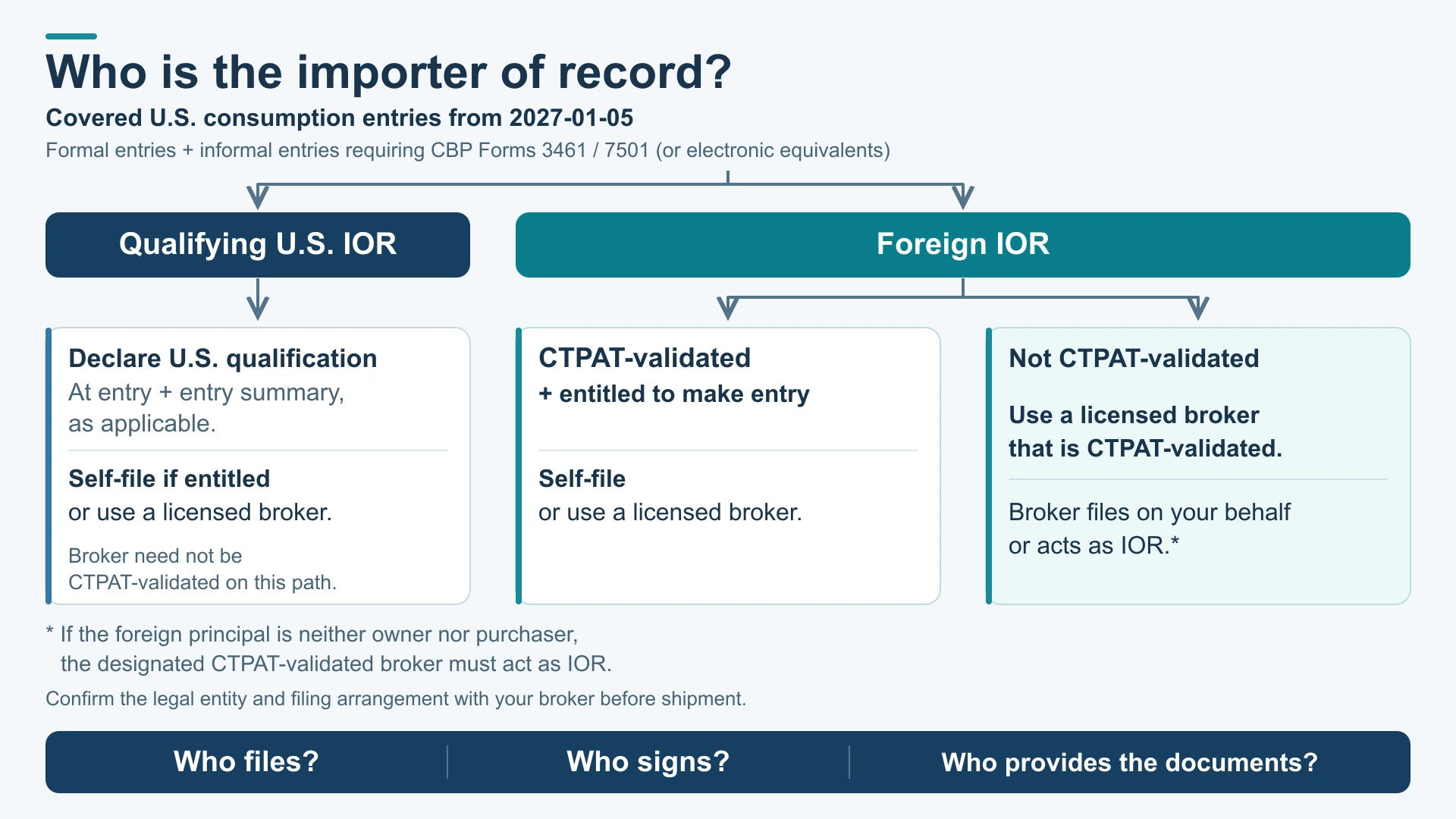
The chart covers formal U.S. consumption entries and informal consumption entries requiring CBP Form 3461 or 7501 or their electronic equivalents under the rules effective January 5, 2027. A qualifying U.S. IOR declares its status at entry and entry summary as applicable. It can file if entitled or use a licensed broker, including one without CTPAT validation. A CTPAT-validated foreign IOR with the right to make entry can file directly or use a licensed broker. A foreign IOR without validation must appoint a licensed, CTPAT-validated broker to file or act as IOR. If the foreign principal is neither owner nor purchaser, the designated validated broker must act as IOR. Before shipment, confirm with the broker who files, who signs and who supplies the documents.
CBP is updating both forms and their electronic equivalents for January 5. Brokers can request extra time for the client-verification duty under § 111.29. The entry requirements above still take effect on January 5. CBP filing bulletin · Federal Register rule, Section VII
CPSC eFiling is a separate step for products subject to certificate-data filing. Confirm that workstream with your compliance team as you settle the customs filing roles. ALLWELL’s CPSC eFiling guide
Buyer checklist before you confirm the order
- Who is the IOR? Record the legal entity, its relationship to the goods as owner or purchaser where relevant, the expected entry date, and the entry type your broker expects to use. Confirm any CTPAT validation the filing requires.
- Who authorizes the broker? Identify the principal and its authorized signer for the customs power of attorney. Ask the broker to confirm whether it will file on the principal’s behalf or serve as IOR, and which principal details the entry requires. Federal Register rule, §§ 141.21–141.22 and 141.46 · CBP filing bulletin
- Who prepares and checks the documents? Assign the commercial invoice, packing list and product details to the parties who hold that information. Ask the importer and broker to confirm who checks classification, declared value and any required certificate data before shipment.